
Nettle Tea Benefits: 7 Possible Benefits, Honest Evidence, and the Safety Fine Print
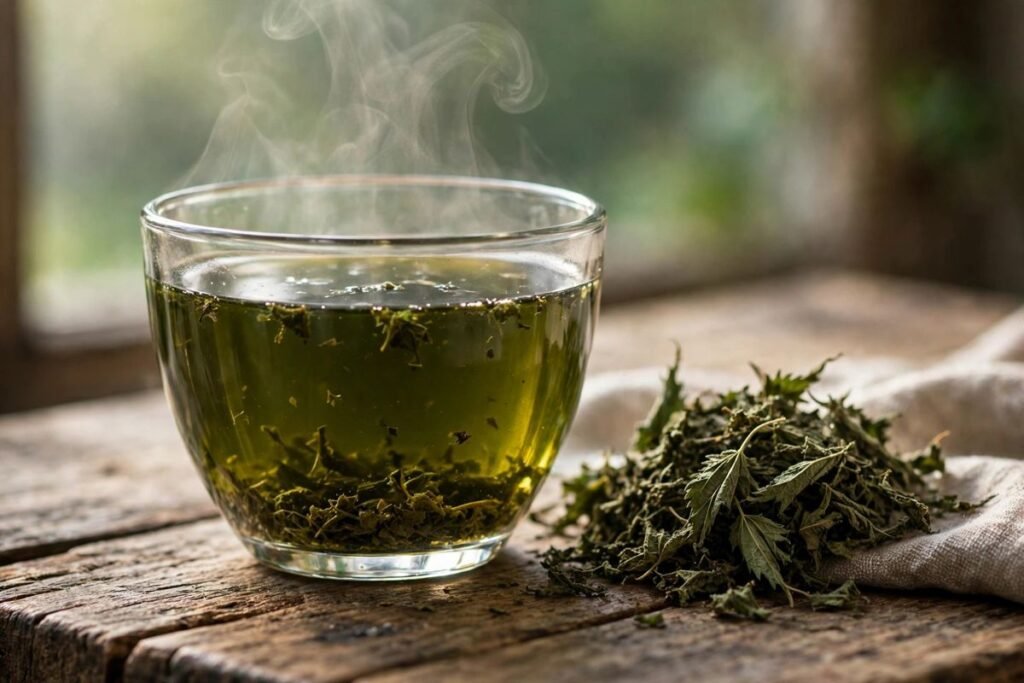
Nettle tea benefits start with a surprise: the plant that stings you in the garden becomes a mild, earthy, caffeine-free brew once its leaves are dried or steeped in hot water. Made from the leaves of stinging nettle (Urtica dioica), nettle tea has been drunk across Europe for centuries as a spring tonic and a daily mineral-rich drink. But how much of its reputation survives contact with real evidence? Some of it does — with an important catch: most of the strongest trials tested concentrated extracts or root preparations, not the cup of leaf tea itself. This guide separates what nettle tea may genuinely offer from what only extracts have shown, and ends with the safety warnings most blogs skip.
What Nettle Tea Actually Is — Leaf, Root, and Extract Are Not the Same
Before the benefits, one distinction that changes everything. Nettle leaf tea is an infusion of the dried above-ground leaves. Nettle root preparations are a different plant part, used traditionally for urinary symptoms linked to an enlarged prostate. And most clinical trials used concentrated extracts — capsules or standardized preparations far stronger than a teacup. Whenever this article says “extract study,” it means the result cannot be pasted onto your cup one-to-one. Europe’s herbal medicines committee (HMPC) classifies nettle leaf and herb as traditional herbal medicines only — meaning long-standing use makes the effect plausible, but clinical trials have not proven it. That honesty is the whole point of this guide.
7 Possible Benefits of Nettle Tea
1. A genuinely mineral-rich cup
Dried nettle leaf is unusually rich in minerals for a tea herb — calcium, iron, magnesium, and potassium, plus vitamins A, C, and K and several B vitamins. A normal cup only draws out part of what is in the leaf, which is why people who drink nettle for its minerals often make a long infusion instead of a quick steep (see brewing below). A squeeze of lemon helps, because vitamin C improves how your body absorbs iron from plant foods. This is nettle tea’s least controversial benefit: it is a nutrient-dense drink, not a medicine.
2. Traditional support for flushing the urinary tract
The HMPC’s traditional-use indication for nettle leaf is relief of minor urinary complaints — increasing urine output to flush the urinary tract. This is a traditional use, not a trial-proven treatment, and it comes with a condition: if urinary symptoms worsen, or fever, painful urination, spasms, or blood in the urine appear, see a doctor rather than drinking more tea. People who must limit fluid intake — for example with severe heart or kidney disease — should not use nettle for flushing at all.
3. Traditional comfort for minor joint aches
Nettle leaf’s second HMPC traditional-use indication is relief of minor articular pain. Folk practice even included lashing aching joints with fresh stinging leaves, a counter-irritant trick modern readers should absolutely not copy. For the tea, the honest version is modest: nettle contains flavonoids and phenolic acids with anti-inflammatory activity in lab and animal research, and traditional use for achy joints is long-standing — but no strong trial shows tea itself easing arthritis pain. Think of it as a traditional comfort drink, not a pain treatment.
4. Seasonal allergy support — one small trial, honestly framed
Nettle’s best-known allergy evidence is a small 1990 trial in which freeze-dried nettle leaf eased hay fever symptoms — but that was a concentrated freeze-dried preparation, not brewed tea, and later reviews note the overall evidence for nettle as an allergy treatment is still lacking. If you drink nettle tea through pollen season, do it as a traditional seasonal habit alongside proven allergy care, not as a replacement for it.
5. Blood sugar support — an extract trial, not a tea trial
In a randomized, double-blind, placebo-controlled trial, 46 patients with advanced type 2 diabetes took 500 mg nettle leaf extract capsules every 8 hours for 3 months alongside their usual diabetes medicines, while 46 took placebo; the extract group ended with significantly lower fasting glucose, 2-hour post-meal glucose, and HbA1c, with no hypoglycemia reported. That is a real, encouraging result — and it is about capsules, not tea. A cup of nettle tea is far weaker, so nobody should expect the same effect from it, and anyone on diabetes medication must talk to their doctor first, because nettle may add to blood-sugar-lowering effects.
6. Prostate and urinary comfort in men — a root extract trial
The strongest nettle trial of all used the root, not the leaf: in a 6-month randomized, double-blind, placebo-controlled trial in 620 men with benign prostatic hyperplasia (BPH), Urtica dioica improved urinary symptom scores (IPSS fell from 19.8 to 11.8, versus 19.2 to 17.7 on placebo), peak urine flow, and residual urine volume. The authors themselves concluded further trials were needed before calling nettle effective. Leaf tea is not root extract, so this benefit belongs on the list with a clear label: promising for the plant, unproven for the cup. Men with urinary symptoms should still get prostate problems properly checked rather than self-treating with tea.
7. Skin, hair, and scalp tradition — including the rinse
Nettle has a long history as a hair rinse: a strong, cooled nettle tea poured through the hair as a final rinse is an old country practice for glossy hair and a fresh-feeling scalp, and it still appears in homemade hair tonics. Drinking it for hair, skin, and nails comes back to the minerals — particularly silica, iron, and zinc — and the evidence here is mostly traditional and anecdotal. Nettle tea will not regrow hair, and any scalp use should stop if irritation appears.
How to Brew Nettle Tea (Two Ways)

Quick cup: Use 1 teaspoon of dried nettle leaf per cup (the HMPC monograph’s single dose for herbal tea is 1.5 g of cut leaf). Pour over just-boiled water, cover, and steep 10–15 minutes, then strain. The brew is deep green and earthy, a little like mild green tea with a hint of cooked spinach. Add lemon if you like.
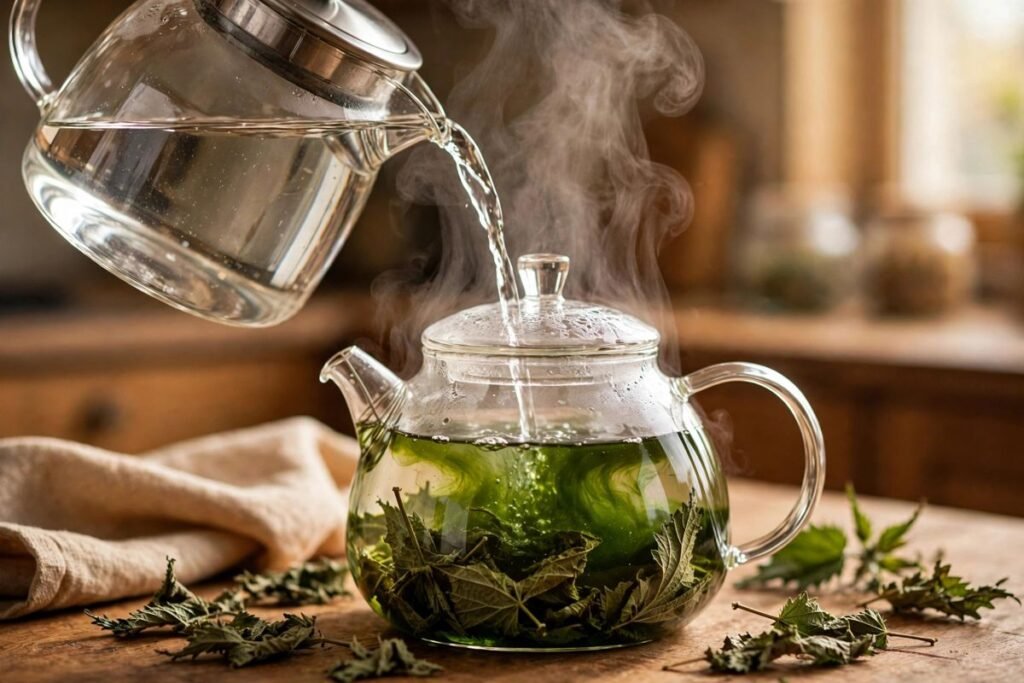
Long mineral infusion: For a stronger, mineral-focused brew, put a generous handful of dried leaf in a large jar, cover with just-boiled water, lid it, and leave it for several hours or overnight, then strain. This is the traditional way nettle drinkers chase the mineral content a quick cup leaves behind.
Fresh leaves need care: fresh nettle stings — wear gloves when handling it, and never eat or brew it raw. Drying, soaking, or cooking removes the stinging chemicals, which is why dried leaf and hot infusions are sting-free.

Simple Nettle Leaf Tea
Ingredients
Method
- Add 1 teaspoon of dried nettle leaf to a cup or teapot.
- Pour over just-boiled water and cover.
- Steep for 10–15 minutes.
- Strain into your cup.
- Add a squeeze of lemon if you like, and sip warm.
What Nettle Tea Won’t Do
Three claims to drop. First, nettle tea does not “detox” or “flush toxins” from your body — your liver and kidneys do that, and the flushing claim is only about urine output for minor complaints. Second, it does not cure diabetes, shrink an enlarged prostate, or replace any medication — the trials above were small, extract-based, and adjunctive. Third, it is not automatically safe because it is natural: nettle interacts with real medicines, and pregnancy is a hard stop (see below).

Safety: Who Should Avoid Nettle Tea or Ask a Doctor First
Pregnancy — do not use. Nettle may stimulate uterine contractions and increase miscarriage risk, and safety in pregnancy has not been established. Breastfeeding — avoid without medical advice, for the same lack of safety data. Medications — check first. Nettle may interact with lithium (reduced clearance, higher lithium levels), diabetes medicines (added blood-sugar lowering), diuretics and blood pressure medicines (added fluid and pressure effects), blood thinners, and alpha-blockers. Heart or kidney disease with fluid restriction — do not use nettle for flushing. Children under 12 — insufficient data, so no tea for young children without medical advice. Allergy: rare allergic reactions occur; stop if you develop a rash, stomach cramps, or diarrhea. General rule: nettle is thought to be possibly safe for short periods (up to about 6 months in supplement form), and you should not combine multiple nettle forms — tea plus capsules plus tincture — without medical advice, since that stacks the dose. If you take any regular medicine, ask your doctor or pharmacist before making nettle tea a daily habit.
Frequently Asked Questions
Does nettle tea sting?
No. Drying, soaking, or steeping in hot water removes the stinging chemicals. Only fresh, raw nettle stings — handle it with gloves.
How many cups of nettle tea a day?
Most guides suggest 2–3 cups a day for a regular habit, and the HMPC monograph frames nettle leaf tea as a short-term traditional remedy, not an indefinite daily medicine. If you drink it daily for weeks, take breaks and check in with your doctor if you take medication.
Is nettle leaf tea the same as nettle root tea?
No. Leaf tea is the mineral-rich, traditional urinary-flushing brew in this article. Root preparations are the ones studied for prostate urinary symptoms — a different plant part with a different traditional use. Do not swap them.
Can I drink nettle tea every day long-term?
Traditional use is seasonal or short-term. There is no strong safety data for indefinite daily use, and the diuretic effect means staying hydrated matters. Keep it a habit with breaks, not a forever prescription.
Does nettle tea help hair growth?
There is no good evidence it regrows hair. The tradition is a cooled-tea hair rinse for shine and scalp freshness, plus mineral content when drunk — a cosmetic tradition, not a treatment.
Nettle tea earns its place in a tea rotation honestly: a mineral-rich, caffeine-free, earthy brew with centuries of traditional use and a handful of genuinely interesting — but extract-based — trials behind it. Drink it for what it is, brew it properly, respect the pregnancy and medication warnings, and it is a fine cup. For more gentle caffeine-free options, see chamomile tea for sleep and marshmallow root tea; for another traditional urinary-flushing herb, dandelion tea; for a fellow earthy root brew, burdock root tea; and for minty digestive comfort, peppermint tea.


