

Catnip tea is usually described two ways: a gentle calming tea for people, and the stuff that sends cats into a happy frenzy. Both are true — but they are not the same effect, and the human side is far less proven than most blogs admit. The honest fact first: no controlled human trial has ever tested catnip tea. Everything below rests on centuries of traditional use, animal and lab studies, and one mosquito experiment.
Catnip Tea at a Glance
| Possible benefit | What the evidence actually says | How strong is it? |
|---|---|---|
| Wind down before sleep | Traditional evening use; animal studies show mild sedation at some doses and the opposite at others | Traditional + mixed animal only |
| Digestion, gas and bloating | Traditional carminative; antispasmodic effects seen in lab and animal work | Traditional only |
| Menstrual cramps | Traditional antispasmodic and emmenagogue use; no human trial | Traditional only |
| Nervous tension | Traditional nervine; lab work suggests GABA-receptor interaction; related-species animal study only | Traditional + lab only |
| Cold comfort | Traditional diaphoretic and steam remedy; no evidence it shortens a cold | Traditional only |
| Tension headache | Traditional use for migraine and tension headache; no human trial | Traditional only |
| Insect repellent | Nepetalactone beat DEET about 10-to-1 in a 2001 lab test — but that was the oil, not the tea | Lab only — not a tea benefit |
What Is Catnip Tea?
Catnip is Nepeta cataria, a hardy mint-family perennial (Lamiaceae) native to Europe and Asia. The tea is an infusion of its dried leaves and white flowers; its defining compound is nepetalactone, a volatile iridoid. A 1995 review records traditional uses as a carminative and emmenagogue, including for infantile colic. (Sarkar, Ancient Science of Life, 1995)
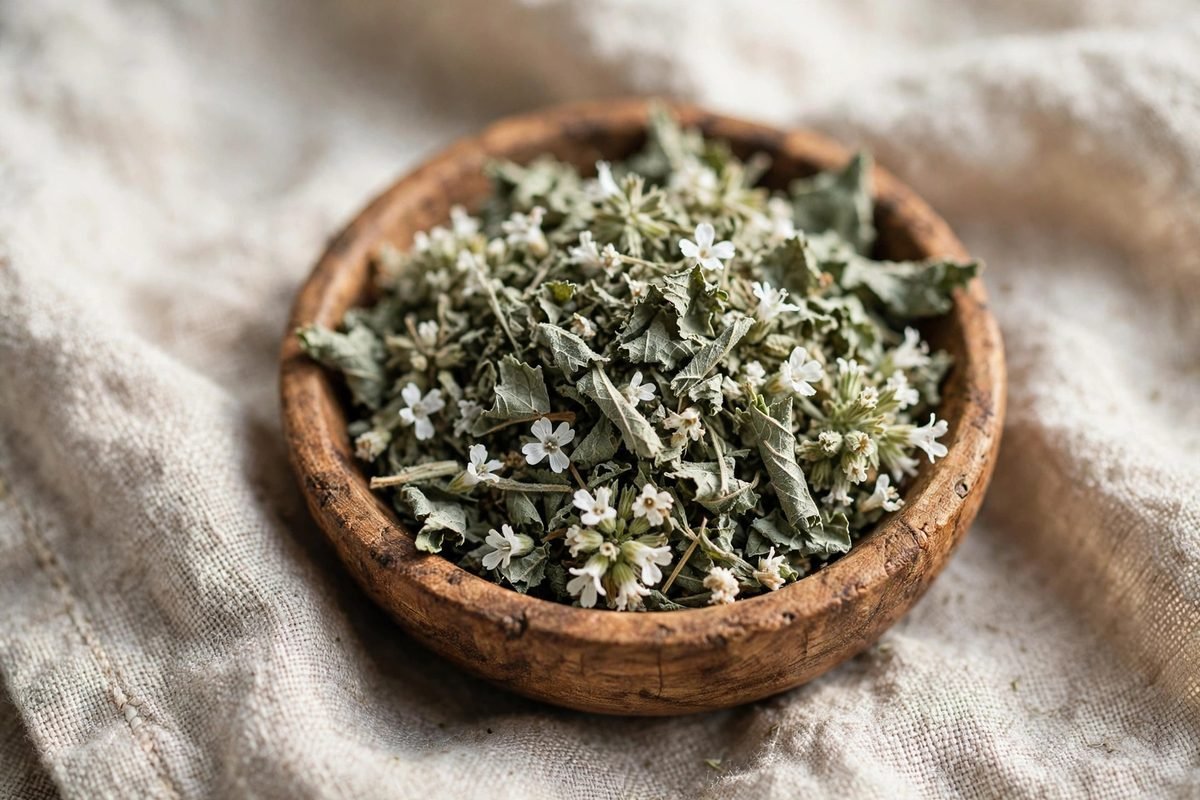
The cat question first, because it confuses everyone:
- Cats smell it; people drink it. In cats, nepetalactone binds to receptors in the nose and triggers rolling, rubbing and play for 5 to 15 minutes in about two-thirds of adult cats. A 2021 study in Science Advances found the response raises β-endorphin levels and leaves the cats with a chemical defence against mosquitoes. (Uenoyama et al., Science Advances, 2021)
- Humans do not get the cat effect. Our brains are wired differently, and drinking the tea does not produce euphoria. What people report is the opposite: a mild, gentle calm.
- “Catmint” is a loose name. It usually means Nepeta cataria, but garden centres sell other Nepeta species as catmint too. Check the Latin name — and do not confuse catnip with lemon balm, a different mint-family herb with its own record. For that one, see lemon balm tea benefits.
Catnip tea has no caffeine and tastes mild, minty and slightly grassy — softer than peppermint. See peppermint tea benefits for a stronger mint-family comparison.
1. May Help You Wind Down Before Sleep
This is the most common reason people reach for catnip tea, and the evidence is honestly thin. Herbalists have used it as an evening sedative for centuries, and WebMD notes it “may help relax the body before bed and promote rest.” (WebMD, reviewed February 2025) Animal studies are mixed: catnip oil lengthened drug-induced sleep in mice, while mice fed the herb in another study slept less. No controlled trial has tested catnip tea for sleep in people — not one. Treat it as a gentle evening ritual, not a sleep treatment. If restless nights are your main problem, chamomile tea for sleep has a stronger human record.
2. May Ease Digestion, Gas and Bloating
Catnip’s oldest human use is as a carminative — a herb that relaxes smooth muscle in the gut, helps gas pass, and eases cramping and bloating. That is why it was traditionally given for colic, indigestion and a “nervous stomach”. Lab work shows nepetalactone relaxes smooth muscle. But plausible is not proven — no human study has measured catnip tea’s effect on digestion. It may soothe a mild, gassy stomach after a heavy meal — not a treatment for persistent digestive problems.
3. May Ease Menstrual Cramps
Herbal traditions used catnip tea for menstrual cramps on the antispasmodic idea: a warm cup may relax cramping muscle. Catnip was also traditionally used as an emmenagogue — an herb that encourages menstrual flow. That second fact is exactly why the pregnancy warning in the safety section matters: the same uterine action traditional herbalists valued is the reason pregnant people should avoid it. No human trial supports the cramp claim — a warm, gentle cup, not a painkiller.
4. May Soothe Nervous Tension
Catnip sits in the herbal category called nervines — herbs used to steady the nerves. Traditional use for restlessness and mild anxiety is well documented, and lab work suggests nepetalactone interacts with GABA receptors — the calming pathway of many sleep medicines, though far more weakly. The most striking animal evidence comes from a related species: the essential oil of Nepeta caesarea — 92 to 95% one nepetalactone isomer — eased pain responses and caused marked sedation in animal tests, both effects blocked by naloxone, pointing to opioid-receptor involvement. (Aydin et al., Journal of Pharmacy and Pharmacology, 1998) That is a related species, in animals, with concentrated oil — a clue, not a claim. For a mint-family herb with a better-studied calm record, see valerian root tea benefits.
5. May Comfort a Cold
Old herbal books list catnip tea for coughs, colds and fever, usually as a warm, sweating (diaphoretic) drink. A hot cup can feel comforting when you are unwell, and the steam may ease a stuffy nose. There is no evidence it shortens a cold or fights a virus — think comfort, not cure.
6. May Ease a Tension Headache
Traditional records also mention catnip for migraine and tension headache — again as a gentle relaxant rather than a painkiller. The reasoning is the same as for cramps and nerves: relax the tension, and the ache may ease with it. No human study has tested this, and a headache that is severe, sudden, or keeps coming back needs a doctor, not a teapot.
7. The One With Real Lab Numbers: Insect Repellent
Here, finally, is a claim with hard numbers — and a catch. In 2001, Iowa State University researchers reported that nepetalactone repelled mosquitoes about ten times more effectively than DEET at the same concentration in a lab tube test: after ten minutes, 20–25% of mosquitoes stayed on the nepetalactone side, against 40–45% on the DEET side. (Scientific American, August 2001) The 2021 Science Advances study then showed why cats rub the plant on their fur: it measurably reduces mosquito landings. (Uenoyama et al., 2021)
The catch: those tests used the concentrated oil, not tea, in a glass tube — not on human skin, outdoors, in wind. Nepetalactone evaporates quickly, and there is still no EPA-registered catnip-based skin repellent. Drinking catnip tea will not keep mosquitoes away; this benefit belongs to the oil.
Catnip Tea vs Catnip Oil vs Extract
| Form | What it is | What the evidence supports |
|---|---|---|
| Tea (infusion) | 1–2 teaspoons dried leaves in hot water, steeped 10 minutes | Traditional calm and digestive use; no human trials |
| Essential oil | Concentrated volatile oil, mostly nepetalactone | Strong insect repellency in lab tests; never drink it undiluted |
| Extract / tincture | Alcohol or water extract of the herb | Animal studies only; doses and safety in people untested |
How to Brew Catnip Tea
Brewing is simple: cover the cup, so the volatile nepetalactone does not escape with the steam. Use food-grade dried leaves — not catnip sold as a cat toy, which may contain fillers. A typical serving is 1 to 2 teaspoons per cup, steeped 10 minutes, up to 2 or 3 cups a day.


Simple Catnip Tea
Ingredients
Method
- Put the dried leaves in a cup or teapot.
- Pour over the just-boiled water.
- Cover and steep for 10 minutes.
- Strain out the leaves.
- Add honey or lemon if you like, and sip slowly in the evening.
Drink it slowly in the evening: mild drowsiness is the most commonly reported effect — pleasant at bedtime, unhelpful before driving. For another gentle evening brew, see lavender tea benefits.

Catnip Tea Safety — Who Should Skip It
Catnip tea is generally regarded as safe for healthy adults in small amounts, but no controlled human trial has recorded its side effects — so the cautions below matter more than the benefits list.
- Pregnancy — avoid. The Natural Medicines database rates catnip likely unsafe in pregnancy: there is evidence it can stimulate the uterus, which might cause a miscarriage. Do not drink catnip tea while pregnant, including for morning sickness or cramps.
- Breastfeeding — avoid. There is not enough reliable information about safety while breastfeeding; stay on the safe side and skip it.
- Children — do not give it. Catnip tea is not recommended for children. Larger amounts can cause vomiting, and a published case report describes a toddler who became hard to rouse — central nervous system depression — after eating a large quantity of catnip. (Osterhoudt et al., Veterinary and Human Toxicology, 1997) Old books mention it for babies’ colic; modern guidance says do not do it.
- Sedatives, sleep medicines and alcohol — use caution. Catnip is mildly sedating, and it may add to the effect of sedatives, sleep aids and alcohol. Do not combine them without medical advice.
- High doses — expect side effects. Many cups or strong brews can cause headache, nausea, vomiting and a washed-out feeling. Catnip is rated possibly unsafe when smoked or taken in high doses.
- Liver or kidney disease — safety not established. There is no reliable safety data for people with severe liver or kidney disease; check with a doctor first.
- Pelvic inflammatory disease (PID) — avoid. Catnip may start menstruation, so women with PID should not use it.
- Mint-family allergy. Catnip is in the mint family. Anyone allergic to mint, basil or other Lamiaceae herbs should be cautious.
- Do not smoke it, and do not buy cat-toy catnip for tea. Smoking catnip is rated possibly unsafe; the tea is the traditional preparation. Catnip sold for cats is not food-grade and may contain fillers — buy dried herb labelled for tea. And remember: this is a gentle home brew, not a treatment for anxiety, insomnia or digestive disease.
Frequently Asked Questions
Is catnip tea safe to drink?
For most healthy adults, small amounts — one or two cups a day — are generally regarded as safe, and cupful amounts have been consumed without serious side effects. But no controlled human trial has established its safety, so pregnant people, breastfeeding parents and children should avoid it, and anyone on sedatives should check with a doctor first.
Will catnip tea make me high like my cat?
No. Cats react through smell, and their response runs through β-endorphin and μ-opioid pathways that do not work the same way in people. In humans the tea produces, at most, mild calm or drowsiness — never the rolling, playful euphoria cats show.
Can I drink catnip tea every day?
Traditional use is one to two cups a day, and many people drink it as an evening habit. There is no long-term safety data, so if you want to drink it daily for weeks, take occasional breaks and talk to a doctor first — especially if you take any regular medication.
Does catnip tea help you sleep?
Traditionally, yes — it is a classic evening herb. Scientifically, the answer is unproven: animal studies are mixed and no human trial exists. It may help you wind down as part of a bedtime routine, but it is not a treatment for insomnia.
Can I drink catnip tea while pregnant?
No. Catnip is rated likely unsafe in pregnancy because it may stimulate the uterus and increase miscarriage risk. Avoid it entirely while pregnant or trying to conceive, and choose a pregnancy-safe herb such as rooibos instead.
Sources
- WebMD — Catnip Tea: Health Benefits, Nutrients per Serving, Preparation Information, and More (medically reviewed 7 February 2025)
- Sarkar M. Pharmacognosy of Nepeta cataria. Ancient Science of Life, 1995; 14(4):225–234 (PMID 22556702)
- Aydin S et al. Nepetalactone: a new opioid analgesic from Nepeta caesarea Boiss. Journal of Pharmacy and Pharmacology, 1998; 50(7):813–817 (PMID 9720633) — related species, animals
- Osterhoudt KC et al. Catnip and the alteration of human consciousness. Veterinary and Human Toxicology, 1997; 39(6):373–375 (PMID 9397511)
- Uenoyama R et al. The characteristic response of domestic cats to plant iridoids allows them to gain chemical defense against mosquitoes. Science Advances, 2021; 7(4):eabd9135 (PMID 33523929)
- Scientific American — Felines’ Favorite Herb Proves Abhorrent to Mosquitoes (Iowa State University / American Chemical Society, 28 August 2001)
- Healthline — Catnip Tea: Health Benefits and Uses (extra source; note: ~8 years old)
Medical disclaimer: This article is for general information only and is not medical advice. Catnip tea has not been tested in controlled human trials. Talk to a doctor before using it if you are pregnant, breastfeeding, giving it to a child, or taking sedatives or other medication.


