
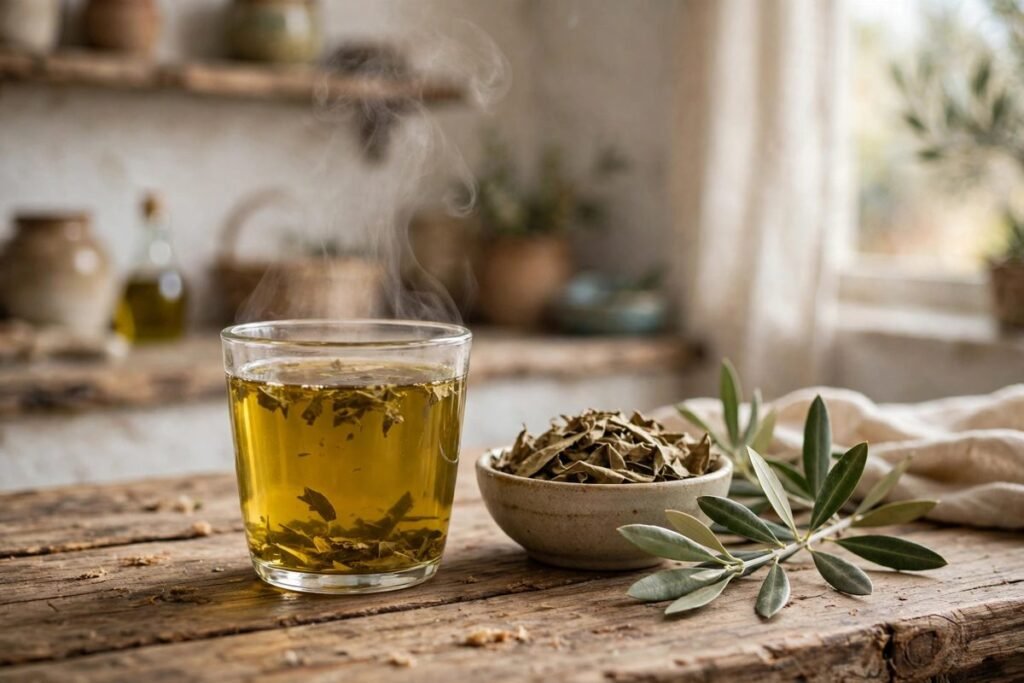
Olive leaf tea benefits are worth a careful look — the olive tree has been a Mediterranean medicine cabinet for centuries, and modern trials of olive leaf extracts do show modest, measurable effects on blood pressure. But a cup of tea is not a standardised extract, and that gap is what this guide tracks.
Quick answer: Olive leaf tea may support healthy blood pressure and blood-sugar balance, thanks to the polyphenol oleuropein — but the strongest evidence comes from standardised extracts, not tea, and only about a fifth of the leaf’s polyphenols reach your cup. If you take blood-pressure or diabetes medicine, or you are pregnant, talk to your doctor first.
What Is Olive Leaf Tea?
Olive leaf tea is an infusion of the leaves of the olive tree (Olea europaea), the same tree that gives us olives and olive oil. The leaves taste mildly bitter and grassy, brew golden-green, and are naturally caffeine-free. In Mediterranean folk medicine the leaf was used for fevers, digestion, and as a tonic for the heart — and the leaf, not the oil, is where the plant concentrates its most studied compound, oleuropein.
Oleuropein is a secoiridoid polyphenol that can make up 6–9% of the dried leaf’s weight, alongside hydroxytyrosol, tyrosol, and caffeic acid. The catch: when leaves are steeped, only about 20% of their polyphenols transfer into the cup — so a tea delivers a gentler, unstandardised dose than the capsules used in trials.

7 Olive Leaf Tea Benefits, Honestly Weighed
Each benefit below carries its evidence grade honestly: traditional use, lab evidence, or human trials — and whether the trials tested tea or something stronger.
1. May support healthy blood pressure — the best-studied benefit
This is the benefit with the most human evidence, and it is still extract evidence, not tea evidence. A 2025 double-blind trial (Lamti et al.) gave olive leaf extract or placebo to 621 adults already being treated for high blood pressure for 12 weeks: 24-hour systolic pressure fell 6.4 mmHg on the extract versus 1.5 mmHg on placebo, and blood-pressure load, lipids, blood sugar, and CRP all improved, with no significant adverse events reported. A 2022 meta-analysis of 12 randomised trials (819 adults) found the same direction at a smaller scale: systolic pressure down 3.86 mmHg overall, and 4.81 mmHg systolic and 2.45 mmHg diastolic in people with hypertension, plus triglycerides down 9.51 mg/dL.
What this means for your cup: the direction is real and the numbers are modest. Tea delivers less oleuropein than the trial capsules, so do not expect trial-sized changes from a daily cup — and never swap a prescribed medicine for tea.
2. Rich in antioxidant polyphenols
Olive leaves are unusually rich in oleuropein and hydroxytyrosol, both strong antioxidants in lab tests. They neutralise free radicals and protect fats, proteins, and DNA from oxidative damage in test-tube and animal studies. That chemistry is genuine, but it is not a human outcome: no trial has shown that drinking olive leaf tea lowers oxidative damage in people.
3. May support blood-sugar balance — with a split verdict
Here the evidence splits, and the split is worth knowing. A 2013 randomised, double-blind crossover trial (de Bock et al.) gave 46 overweight middle-aged men olive leaf polyphenols (51.1 mg oleuropein and 9.7 mg hydroxytyrosol a day) for 12 weeks: insulin sensitivity improved 15% and pancreatic beta-cell responsiveness improved 28% versus placebo. But the 2022 meta-analysis above, pooling 12 trials, found no meaningful change in glucose, insulin, or HbA1c markers overall. One small positive trial against a flat pooled result is exactly the kind of honest disagreement a good guide should show. If blood sugar is your main concern, cinnamon tea has its own cautious evidence base — and neither replaces medical care.
4. May help the cholesterol picture
The same 2022 meta-analysis found triglycerides down 9.51 mg/dL overall, and in people with hypertension total cholesterol down 9.14 mg/dL and LDL cholesterol down 4.6 mg/dL. The 2025 trial also reported an improved lipid profile. These are small shifts, measured on extracts over 12 weeks — a cup of tea alone is unlikely to move a cholesterol panel.
5. Traditional immune support — lab evidence only
Olive leaf polyphenols show antibacterial, antiviral, and antifungal activity in lab studies, and oleuropein can interfere with how some microbes replicate. But lab dishes are not people: no good human trial has shown that olive leaf tea prevents colds or flu. If immune support is your goal, elderberry tea has the better human trial record — and the honest framing for olive leaf is “interesting lab evidence, unproven in people”.
6. May soothe digestion (traditional use)
In Mediterranean folk use, olive leaf tea was drunk for indigestion, heartburn, gastritis, and colitis, and to support bile flow and liver comfort. There are no human trials testing olive leaf tea for digestion, so this stays a traditional, plausible use — a gentle after-meal cup, not a treatment for reflux or any gut condition.
7. May help with mild water retention (the one EMA recognises)
Europe’s herbal medicines committee is the only regulator to give olive leaf a formal traditional-use indication — and it is a narrow one. The EMA monograph on olive leaf concludes that, on long-standing use, olive leaf can be used to promote the elimination of water through the kidneys in mild cases of water retention, after serious conditions have been excluded by a doctor. At the time of assessment, no side effects had been reported with these medicines — but the monograph also says olive leaf must not be taken by people whose conditions require reduced fluid intake, such as severe heart or kidney disease.
The Extract-vs-Tea Problem, in One Paragraph
Almost everything impressive about olive leaf comes from standardised extracts — capsules delivering roughly 50–200 mg of oleuropein a day for 6–12 weeks. Tea is a weaker, variable version of the same plant: a typical cup uses 1 teaspoon of dried leaves, and only about a fifth of the leaf’s polyphenols make it into the water. The honest hierarchy: extracts have modest, real trial evidence for blood pressure and lipids; tea has traditional use plus a plausible, smaller dose of the same compounds.
How to Brew Olive Leaf Tea
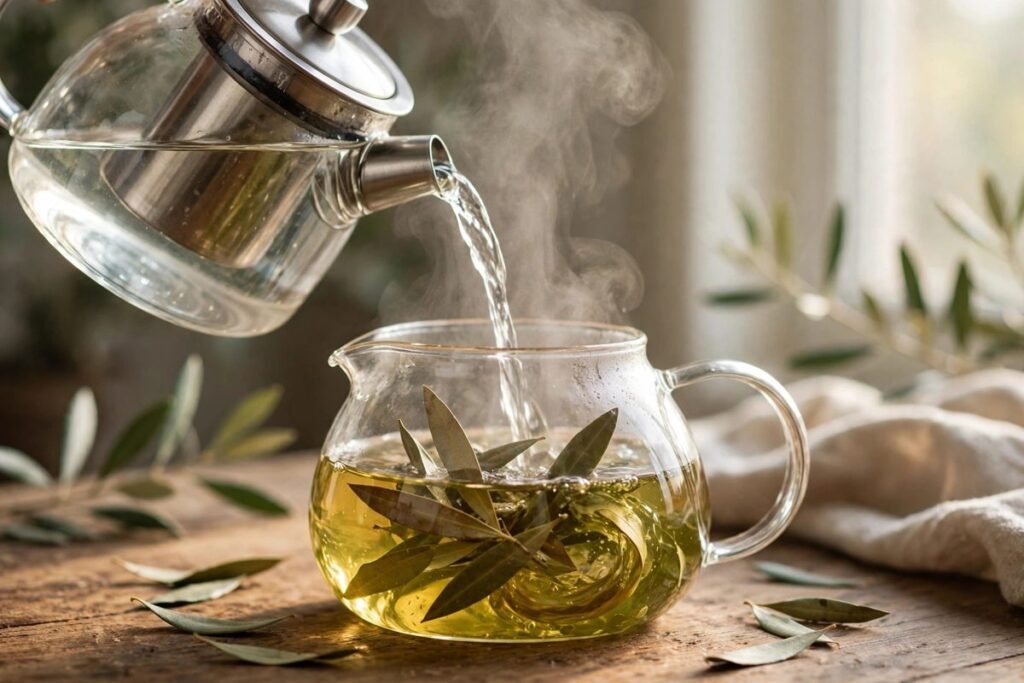
Use dried olive leaves from a reputable supplier — fresh leaves from a garden tree work too, but wash them first and expect a stronger, more bitter cup. The recipe card below gives the exact amounts and steps.
| At a glance | Detail |
|---|---|
| Leaves | 1 teaspoon dried olive leaves per cup |
| Water | 1 cup (250 ml), just boiled |
| Steep | 10 minutes, covered |
| Caffeine | None — fine morning or evening |
| Taste | Mildly bitter and grassy; lemon or honey softens it |
| How often | 1 cup a day is a sensible start |
Two common mistakes: steeping less than 5 minutes (too weak to taste the leaf at all) and steeping fresh leaves for 20+ minutes (very bitter). Ten minutes covered, with dried leaves, is the sweet spot.

Safety: Who Should Avoid Olive Leaf Tea or Ask a Doctor First
Olive leaf tea is generally gentle, but it is not for everyone.
- Blood-pressure medicine: olive leaf may lower blood pressure, so it can add to the effect of prescribed drugs. If you take antihypertensives, ask your doctor before drinking it regularly.
- Diabetes medicine: olive leaf may lower blood sugar, so it can add to the effect of diabetes drugs. Check with your doctor, and watch for low-blood-sugar symptoms if you combine them.
- Pregnancy and breastfeeding: not recommended — there is not enough safety data for these groups. Skip it until a doctor says otherwise.
- Severe heart or kidney disease: the EMA monograph says olive leaf must not be taken where reduced fluid intake is recommended. If that describes you, do not use it.
- Olive allergy: if you are allergic to olives or olive products, avoid the tea. Rare skin rashes have been reported.
- High doses: large amounts may cause low blood pressure, low blood sugar, or diarrhoea in sensitive people. One cup a day is a sensible amount; more is not better.
- Blood thinners: olive leaf compounds may interact with anticoagulants such as warfarin. Tell your doctor if you take one.
If you feel dizzy, unusually tired, or shaky after drinking it, stop and talk to your doctor — those can be signs of blood pressure or blood sugar dropping too low.
Frequently Asked Questions
Is olive leaf tea the same as olive oil?
No. Olive oil comes from the fruit; the tea comes from the leaves. The leaves concentrate oleuropein, while the oil is mostly fat with smaller amounts of the same polyphenols. They are related, not interchangeable.
Does olive leaf tea have caffeine?
No — it is naturally caffeine-free, so it works morning or evening. If you want a calm evening cup, it pairs well with chamomile tea or lemon balm tea in a rotation.
Can olive leaf tea replace blood-pressure medicine?
No. Trials show modest average falls in blood pressure from standardised extracts, and tea delivers even less. It is a complement to — never a replacement for — prescribed treatment and a doctor’s plan.
How much olive leaf tea can I drink a day?
One cup a day, made with 1 teaspoon of dried leaves, is a sensible amount. There is no established safe dose for tea specifically, and more is not better — high doses are where the low-blood-pressure and stomach complaints show up.
Can I use fresh olive leaves instead of dried?
Yes, if you can identify the tree as Olea europaea and wash the leaves well. Use about 1 tablespoon of chopped fresh leaves per cup and steep 10 minutes. Fresh leaves taste stronger and more bitter than dried ones.
Sources
- European Medicines Agency — Oleae folium (olive leaf) herbal monograph (traditional use: mild water retention; severe heart/kidney disease caution)
- Lamti et al., Journal of Hypertension, 2025 (PMID 40990594) — 621-patient randomised trial: 24-hour systolic pressure −6.4 mmHg on extract vs −1.5 mmHg on placebo over 12 weeks
- Razmpoosh et al., Diabetology & Metabolic Syndrome, 2022 (PMID 36271405) — meta-analysis of 12 randomised trials, 819 adults: systolic pressure −3.86 mmHg, triglycerides −9.51 mg/dL
- de Bock et al., PLoS ONE, 2013 (PMC3596374) — 46 overweight men: insulin sensitivity +15%, beta-cell responsiveness +28% on olive leaf polyphenols
- Tua Saúde — Olive Leaf Tea (traditional uses; pregnancy, blood-pressure and diabetes medication cautions)

Simple Olive Leaf Tea
Ingredients
Method
- Add 1 teaspoon of dried olive leaves to a cup or teapot.
- Pour 1 cup of just-boiled water over the leaves.
- Cover and steep for 10 minutes.
- Strain into your cup.
- Add lemon or honey if you like, and sip warm.


