
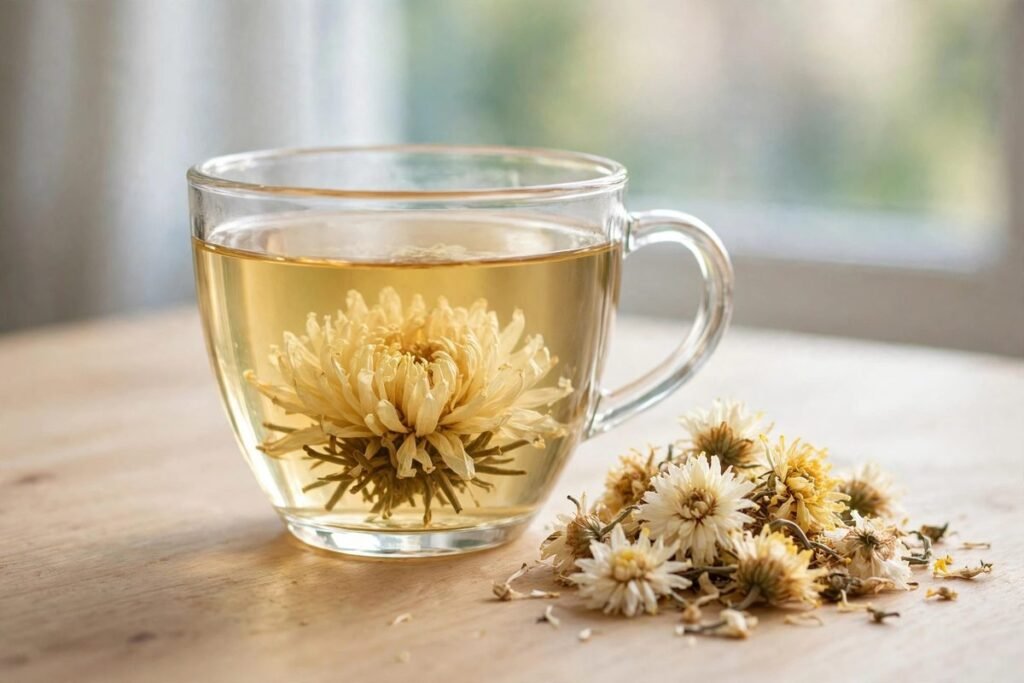
Chrysanthemum tea is the pale-gold, caffeine-free brew East Asia reaches for when eyes feel tired and the day feels overheated. It is made from dried chrysanthemum flowers — most often Chrysanthemum morifolium, sold as ju hua — steeped in hot water until the petals open and the cup turns the colour of light honey. This guide looks at what it may actually offer, what the research really tested, how to brew it, and who should skip it.
Chrysanthemum Tea at a Glance
In short: chrysanthemum tea may help tired eyes feel more comfortable and makes a calming, caffeine-free evening drink. The strongest human evidence comes from a trial of a multi-herb formula, not plain tea — so treat the benefits as possible, not proven. And if ragweed or daisies make you sneeze, this flower can too.
| Possible benefit | What we know | How strong is the evidence? |
|---|---|---|
| Tired, screen-strained eyes | A 360-person trial of a formula containing chrysanthemum extract improved eye-fatigue scores | Moderate — a formula, not tea alone |
| Calm evenings | Apigenin, also found in chamomile, is linked in lab studies with gentle calming effects | Traditional use + lab studies only |
| Headache and a “heated” feeling | Traditional use for wind-heat headaches; no human trial | Traditional use only |
| Sore throat in early colds | A traditional comfort drink; lab studies show anti-inflammatory activity | Traditional use + lab studies only |
| Antioxidant support | The flowers contain luteolin, apigenin and other flavonoids | Lab evidence |
| Blood pressure | Animal studies only; no human trial of the tea | Not proven |
What Is Chrysanthemum Tea?
Chrysanthemum tea is an herbal infusion brewed from the dried flower heads of the chrysanthemum plant, a member of the daisy family. In China, called ju hua, it has been drunk for well over a thousand years — early medical texts describe it as a cooling herb for red eyes, headaches and feverish feelings. It is naturally caffeine-free.
Two species matter, and the label tells you which one you are buying:
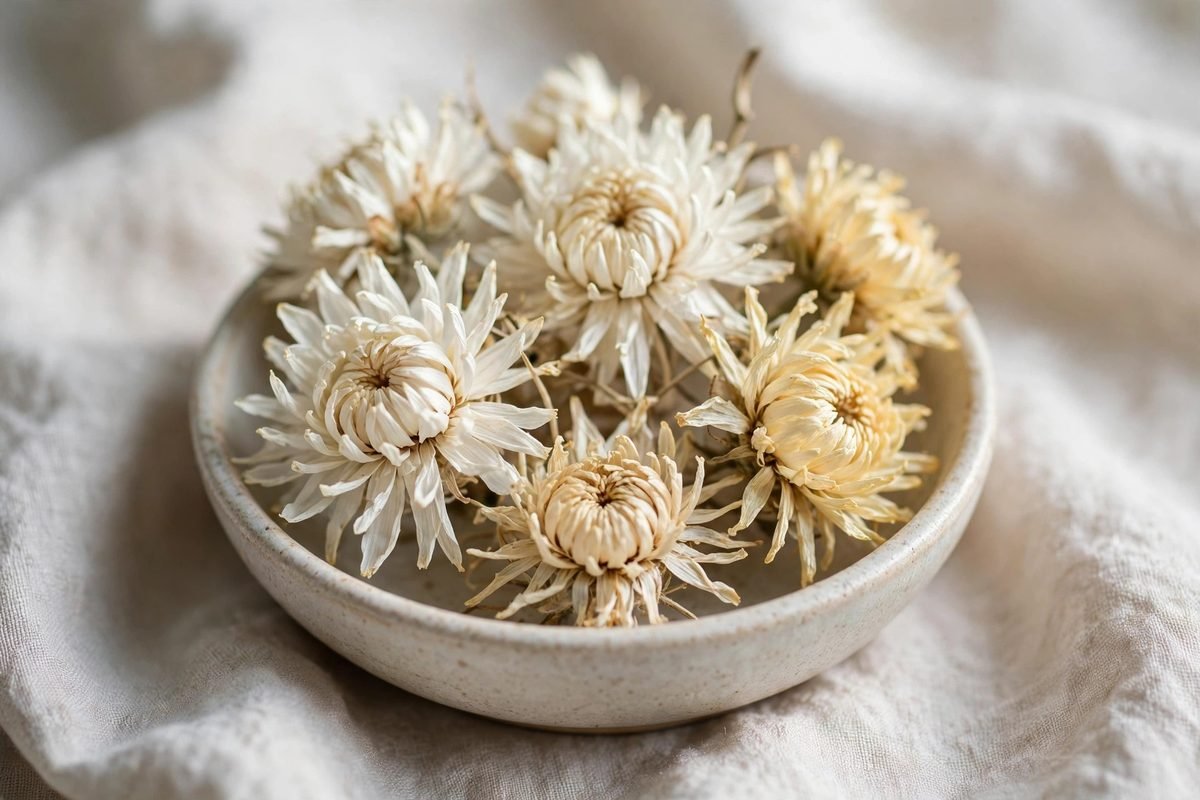
- Chrysanthemum morifolium (garden chrysanthemum) — the usual tea flower. The best-known type is Hangbai Ju, white flowers that brew mild and sweet — the one to buy for everyday tea.
- Chrysanthemum indicum (wild chrysanthemum) — smaller, stronger and more bitter, used more as a medicinal herb than a daily drink, with a different flavonoid profile.
Good dried flowers are whole, unbroken heads — pale yellow-white and fragrant. Store them airtight, away from light, and use within a few months.
7 Chrysanthemum Tea Benefits, Honestly Weighed
Where the research tested an extract or a mixed formula instead of a cup of tea, this guide says so plainly.
1. May ease tired, screen-strained eyes
This is the flower’s best-known claim, and it has the best human evidence on this list — with one big honest footnote. A 2020 randomised, double-blind, placebo-controlled trial in The American Journal of Clinical Nutrition tested a botanical formula of lutein ester, zeaxanthin, and blackcurrant, chrysanthemum and goji berry extracts in 360 adults with eye fatigue, for 90 days. Compared with placebo, it improved eye-fatigue scores — soreness, blurred vision, dry eye, foreign-body sensation and tearing — and increased focusing time. PubMed PMID 32542334
The footnote matters: the trial tested a combination formula in chewable tablets, not a cup of tea. Chrysanthemum was one of five ingredients, at a standardised dose. A cup of tea is a smaller, unstandardised dose — so the honest reading is that chrysanthemum may contribute to eye comfort, not that a cup of tea will fix tired eyes.
2. A calm, caffeine-free evening cup
Chrysanthemum contains apigenin, the same flavonoid behind much of chamomile tea‘s gentle reputation. In laboratory studies apigenin interacts with calming pathways in the brain, which fits the traditional description of chrysanthemum as a herb that “settles the spirit”. No human trial proves the tea itself relaxes you — treat this as plausible and traditional, not proven.
What is certain is the practical side: the tea has no caffeine, so it will not keep you awake the way a second coffee would — and lemon balm tea is another caffeine-free herb for the same evening routine.
3. May soothe the “heated” headache
In traditional Chinese medicine, chrysanthemum is a “cooling” herb for wind-heat: a headache with red or tired eyes, a flushed face and a feeling of being overheated. There is no modern human trial testing it for headaches, so this stays a traditional-use claim — and linden tea is another traditional choice for the same kind of tense evening.
4. Comfort for a scratchy throat in early colds
A warm cup is a classic first response to a sore throat and the feverish feeling of an early cold. Laboratory studies have found that chrysanthemum flavonoids can damp down inflammatory pathways, which may help explain the soothing feeling — but lab studies are not proof in people, and no trial shows the tea shortens a cold. Use it as comfort, not treatment. For cold-season comfort, elderberry tea is the better-studied companion in the same cupboard.
5. Antioxidant flavonoids in every cup
Chrysanthemum flowers are rich in flavonoids — mainly luteolin, apigenin and quercetin — plus phenolic acids such as chlorogenic acid. In laboratory tests these compounds neutralise free radicals, the unstable molecules linked to cell damage. Keep it in proportion: a cup adds a small amount of antioxidants to a diet that already gets them from fruit, vegetables and other teas. The tea is a top-up, not a shield.
6. A gentle ritual that replaces a second coffee
Some benefits are about what you stop doing. A mid-afternoon chrysanthemum tea replaces a second coffee, which means less caffeine late in the day and an easier evening. The ritual — warming the cup, watching the flowers open, sitting for four minutes — is a small pause in a screen-filled day. No trial measures that pause, but anyone with tired eyes knows what it is worth.
7. May support comfort after heavy, rich meals
Traditional use also covers digestion: the cooling flower is drunk after greasy or heavy food, when the stomach feels hot and sluggish. There is no human trial behind this, and it is not a “detox” — the liver needs no tea to do its job. Treat it as a light after-meal drink, nothing more.
What Chrysanthemum Tea Does Not Do
Chrysanthemum tea does not treat high blood pressure. Animal studies — including a 2022 comparison of C. morifolium and C. indicum in hypertensive rats — found blood-pressure-lowering effects from extracts, linked to compounds such as luteolin and linarin. But no human trial has tested the tea for blood pressure, and blog-quoted “5 mmHg” figures trace to no verifiable trial. Do not swap medicine for tea, and do not trust a number with no study behind it. MDPI, International Journal of Molecular Sciences, 2022
It also does not cure colds or flu, detox the liver, improve eyesight, treat diabetes or cause weight loss. The eye trial improved comfort, not vision.
How to Brew Chrysanthemum Tea
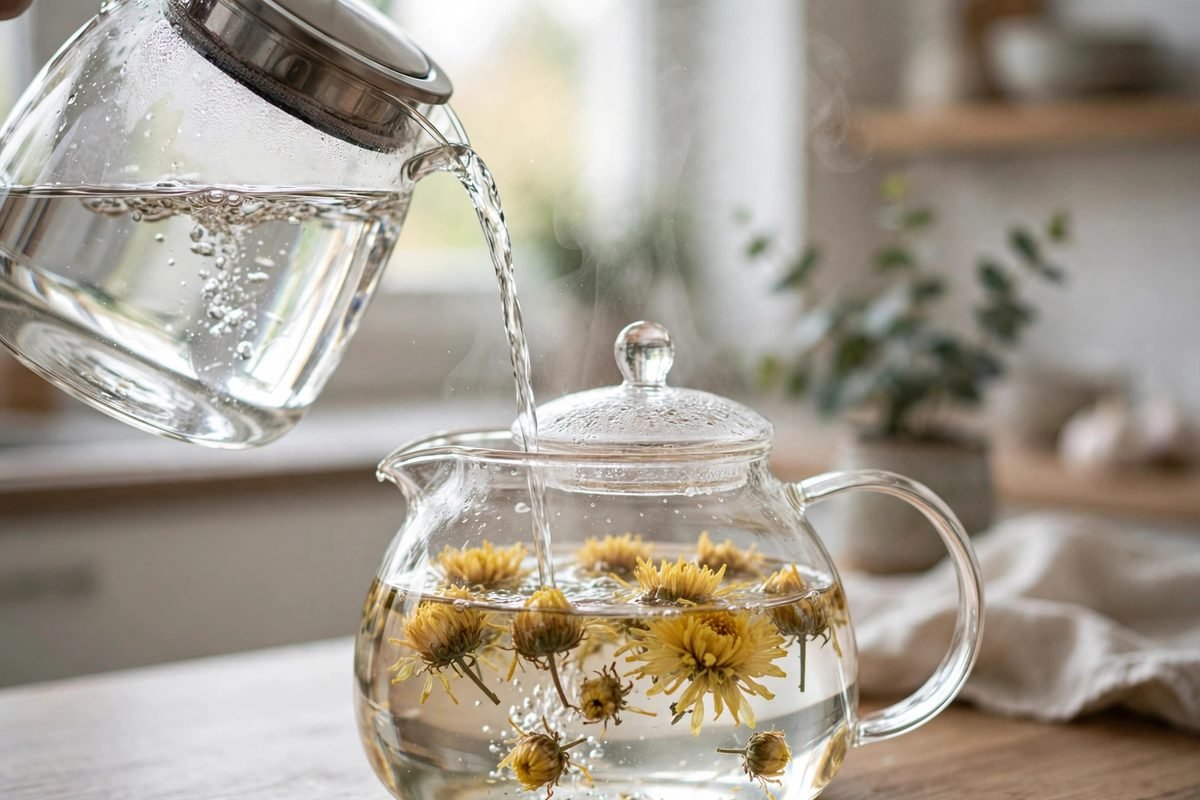
Two details decide whether the cup is floral or bitter: water just off the boil, never a hard rolling boil over the flowers, and not too many flowers. Six per cup is the sweet spot.
What to buy: whole dried Hangbai (C. morifolium) flowers. Avoid dusty, broken petals; if the bag smells stale, the tea will taste stale.
Brewing, step by step: warm your cup with hot water and tip it out; add 6 dried flowers (about 2 g); pour 1 cup (250 ml) of water just off the boil over them; cover and steep for 4 minutes; strain; add 1 teaspoon of honey if you like, and sip warm. The flowers can be re-steeped 2 to 3 times — the second steep is often sweeter. A teaspoon of goji berries (about 5 g) is traditional, not required.
Common mistakes: boiling the flowers hard, which turns the cup bitter; using a whole handful, which tastes medicinal; and drinking it first thing on an empty stomach — some people find it unsettling, so most prefer it with or after food.
Simple Chrysanthemum Tea
Ingredients
Method
- Warm your cup with hot water and tip it out.
- Add 6 dried chrysanthemum flowers to the cup or a small teapot.
- Pour 1 cup of just-off-the-boil water over the flowers.
- Cover and steep for 4 minutes, then strain.
- Add honey if you like, and sip warm.

Safety: Who Should Be Careful (or Skip It)
Allergy comes first. Chrysanthemum belongs to the Asteraceae (daisy) family, the same family as ragweed, daisies, marigolds, chamomile, dandelion and yarrow. The family shares allergy-triggering proteins called panallergens, and its plants contain sesquiterpene lactones that can cause skin reactions. Research has documented cross-reactivity between ragweed pollen and chrysanthemum, and herbal products from this family have triggered reactions in people with ragweed or mugwort pollen allergy. Symptoms range from a rash, itching or swelling to breathing trouble. If ragweed, daisies or chamomile have ever given you a reaction, do not drink it without asking your doctor first. PMC, Diagnostic Workup in IgE-Mediated Allergy to Asteraceae, 2024
Pregnancy and breastfeeding: there is not enough safety data, so avoid it unless a clinician advises otherwise.
Medicines: check with your doctor or pharmacist first if you take blood-pressure medicine, diabetes medicine, blood thinners or other anticoagulants, sedatives, or immunosuppressants. Extracts carry more interaction risk than a cup of tea, but the check is still worth making.
Other cautions: a small number of people develop sun sensitivity after handling or drinking chrysanthemum; too much can cause stomach upset, dizziness or a dip in blood pressure. Most guides suggest 1 to 3 cups a day. Stop and seek care promptly if you develop a rash, itching, swelling or breathing difficulty.
Sudden vision changes, severe eye pain, light sensitivity with nausea, or a headache that is unusual for you need prompt medical attention — no herbal tea substitutes for that.
Frequently Asked Questions
Is it safe to drink chrysanthemum tea every day?
For most healthy adults, 1 to 3 cups a day is the amount herbal guides generally describe as reasonable. Take breaks rather than drinking it heavily for months on end, and stop if you notice a rash, itching or stomach upset.
Morifolium or indicum — which should I buy?
For everyday tea, buy C. morifolium — ideally Hangbai Ju, the white flowers. It brews mild and sweet. C. indicum (wild chrysanthemum) is smaller, stronger and more bitter, and is used more as a medicinal herb than as a daily drink. Check the label before you buy.
Does chrysanthemum tea improve eyesight?
No. The human trial improved eye-fatigue comfort — soreness, dryness and blurred vision from screen use — not eyesight itself, and it tested a multi-herb formula, not plain tea. It is not a treatment for any eye disease.
Can pregnant women drink chrysanthemum tea?
There is not enough safety data, so the usual advice is to avoid it during pregnancy and breastfeeding unless a clinician says otherwise.
Is chrysanthemum tea the same as chamomile tea?
No, but they are cousins. Both belong to the Asteraceae family, both contain apigenin, and both are caffeine-free. Chrysanthemum is the more floral, “cooling” flower in Chinese tradition, while chamomile is the better-studied sleep herb in the West. Because they are related, an allergy to one means caution with the other.
Sources
- Kan J et al. “A novel botanical formula improves eye fatigue and dry eye: a randomized, double-blind, placebo-controlled study.” The American Journal of Clinical Nutrition 2020;112(2):334–342. PubMed PMID 32542334 — 360 adults, 90 days; combination formula with lutein, zeaxanthin, blackcurrant, chrysanthemum and goji berry extracts.
- “Comparison of the Chemical Components, Efficacy and Mechanisms of Action of Chrysanthemum morifolium Flower and Its Wild Relative Chrysanthemum indicum Flower against Liver-Fire Hyperactivity Syndrome of Hypertension.” International Journal of Molecular Sciences 2022;23(22):13767. MDPI — morifolium vs indicum; animal and network-pharmacology evidence for blood pressure.
- “Diagnostic Workup in IgE-Mediated Allergy to Asteraceae Weed Pollen and Herbal Medicine Products in Europe.” Journal of Clinical Medicine 2024. PMC11433692 — ragweed/mugwort cross-reactivity with Asteraceae herbal products.
- Ključevšek T, Kreft S. “Allergic Potential of Medicinal Plants From the Asteraceae Family.” Health Science Reports 2025;8:e70398. PMC11847717 — panallergens, sesquiterpene lactones, cross-reactivity across the family.
- “Studies of the Cross-Allergenicity of Compositae Pollens (I).” Japanese Journal of Allergology 1977. J-STAGE — skin-test and RAST evidence of cross-allergenicity between short ragweed, wormwood, chrysanthemum, dandelion and other Compositae pollens.
This article is for education only and is not medical advice. Herbal teas can cause allergic reactions and may interact with medicines. If you are pregnant, breastfeeding, take prescription medicine, or have an allergy to ragweed or other daisy-family plants, ask a qualified clinician before drinking chrysanthemum tea.


