

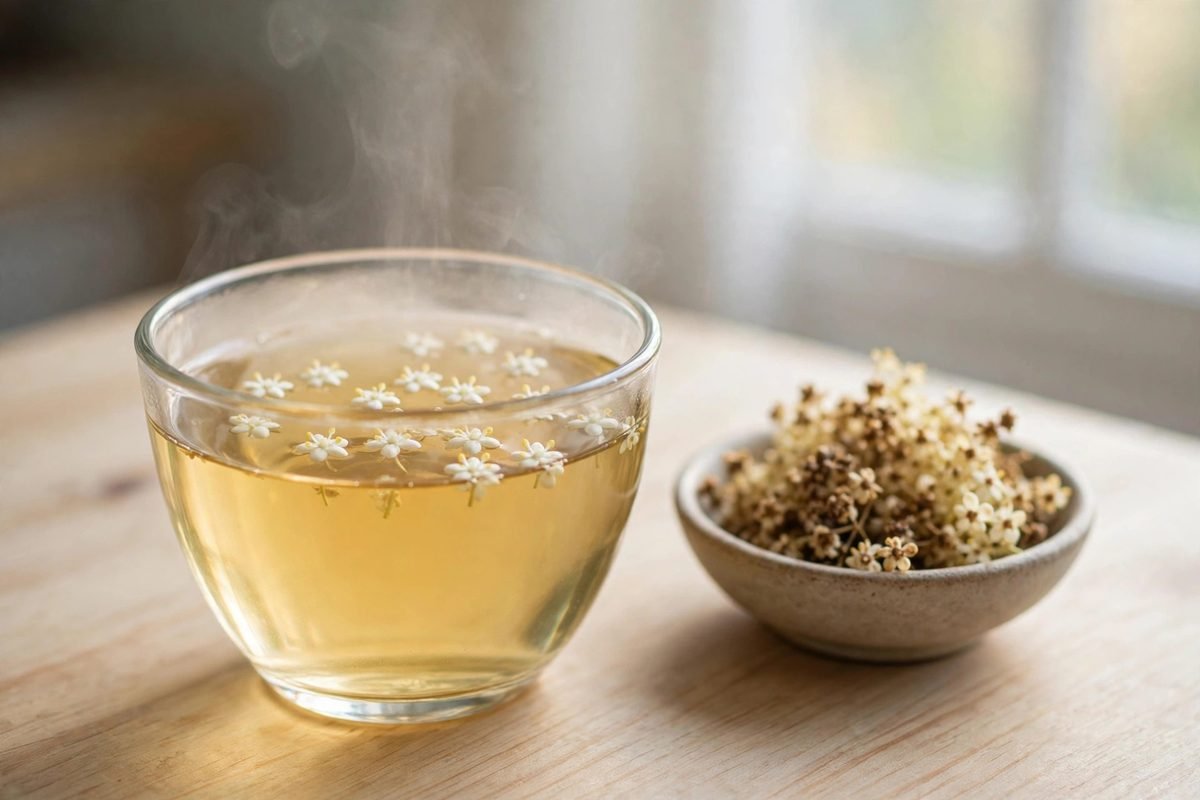
Elderflower tea is the quiet classic of European herbalism: a pale-gold, honey-scented infusion made from the cream-white blossoms of the elder tree (Sambucus nigra). For centuries it has been the first cup poured at the first sign of a cold — the warming “fever tea” grandmothers reached for before anything else. But here is the honest part up front: no clinical trial has ever tested elderflower tea itself for colds. What it does have is an official European traditional-use monograph, a well-mapped flavonoid profile, and several hundred years of uneventful use. This guide weighs all seven of its possible benefits honestly, shows exactly how to brew it, and draws the safety line most blogs skip — the one between the flower and the berry.
Short answer: Elderflower tea may gently support comfort during the early days of a cold, ease a stuffy nose, and offer a calm, caffeine-free evening cup. The European Medicines Agency recognises it for the relief of early cold symptoms on the basis of traditional use — not proven trials. Brew 2–5 g of dried flowers per cup, up to 3 times a day, for no more than a week, and never swap in leaves, bark, or raw berries.
| Quick facts | Elderflower tea |
|---|---|
| Plant | Sambucus nigra (European elder), flowers only |
| Official status | EMA traditional-use monograph for early cold symptoms (2008) |
| Tea dose (EMA) | 2–5 g dried flowers per cup, up to 3 times daily |
| How long | No more than 1 week at a time |
| Who can use it | Adults and adolescents over 12 only (EMA) |
| Caffeine | None — naturally caffeine-free |
| Key compounds | Flavonoids (rutin, quercetin, kaempferol) + chlorogenic acid |
7 Possible Benefits of Elderflower Tea, Honestly Weighed
1. Early-cold comfort — the one use Europe officially recognises
This is the benefit with actual regulatory backing. The European Medicines Agency’s herbal monograph for Sambuci flos (elder flower) concludes that, on the basis of long-standing use, elderflower preparations “can be used for the relief of early symptoms of common cold.” The German Commission E likewise approves elderflower for colds. The crucial honesty point: both approvals are traditional use, meaning effectiveness is plausible from 30+ years of safe use, not proven by clinical trials — the EMA itself notes the lack of clinical studies with elder flower. So the fair claim is comfort during the first days of a cold, not a cure and not a shortened illness.

2. The classic “fever tea” — gentle warming and sweating
Traditional herbalists call elderflower a diaphoretic: drunk hot, it encourages light sweating. That is why it anchors the old “influenza tea” blend — elderflower with yarrow and peppermint — still kept on herbalists’ shelves for cold season. A hot cup, a warm blanket, and rest is a ritual, not a medicine, but the warming effect itself is real and pleasant: the tea is aromatic, mildly sweet, and genuinely soothing on a sore-feeling throat. Expect comfort, not a broken fever on a timetable.
3. Stuffy nose and sinus support
Traditional and official herbal use both recognise elderflower for nasal congestion and discharge linked to sinusitis and hay fever. The mechanism is unglamorous but sensible: hot steam plus a warm, mucus-soothing drink, with the flower’s flavonoids and phenolic acids in the background. It will not unblock a nose the way a decongestant spray does, and nobody has measured the effect in a trial — but as a gentle, repeatable cup during a stuffy week, it is one of the better-tolerated traditional options.
4. A flavonoid-rich infusion — more phenolics than elderberry tea
Here the lab data is genuinely interesting. A 2017 study of commercial Sambucus nigra infusions (Plant Foods for Human Nutrition, PMID 28084608) found elderflower teas contained more abundant phenolic compounds than elderberry teas: total flavonoids ran 5.27–13.19 mg rutin equivalents per gram in flower infusions versus 2.60–4.49 mg in berry infusions, with quercetin and myricetin the leading flavonols. A separate 2021 chemical analysis (Biomolecules, PMID 34439888) found quercetin and chlorogenic-acid derivatives made up 86% of the phenolics in a hot-water flower extract. Honest framing: these are lab measurements of compounds in a cup, not proof of health effects in your body — but the flower is, measurably, the phenolic-rich part of the plant.
5. Gentle digestion after heavy meals
Elderflower has a quieter traditional reputation as a mild digestive soother and light diuretic — the kind of herb reached for after a rich meal or during a sluggish-feeling day. There are no human trials behind this use, and the diuretic effect is mild, not a cleanse. Think of it as a light, floral alternative to a second coffee after dinner: warm, easy on the stomach, and caffeine-free, so it will not cost you sleep.

6. Skin comfort — the cooled-wash tradition
Victorian cosmetic makers built a whole industry on elderflower water, and traditional use includes cooled elderflower tea as a wash or compress for sun-warmed skin and minor scrapes, thanks to its mild astringency. This is tradition, not trial evidence — do not expect anti-ageing results, and never put tea on broken or infected skin. As a gentle, cooled compress on intact, irritated skin, it is a low-risk traditional use worth knowing about.
7. A calm, caffeine-free evening cup
Elderflower tea contains no caffeine and no stimulant compounds, and its soft floral flavour — somewhere between honey, lychee, and pear — makes it an easy evening ritual. It is not a sedative and will not make you sleepy the way chamomile or valerian might, but as a wind-down drink it has one real advantage: it replaces the late-night habit of reaching for something caffeinated or sugary, and that swap alone is worth something.
Elderflower vs Elderberry — Don’t Mix Them Up
This is the safety point that matters most, and it is where blogs most often go wrong. The flower and the berry come from the same tree but are not interchangeable:
- Elderflower (the blossom) is the part the EMA monograph covers. No side effects had been reported with elderflower medicines at the time of the assessment.
- Elderberry (the fruit) is a different preparation with its own evidence — our elderberry tea guide covers it separately.
- Raw or unripe elderberries — and the leaves, bark, stems, and roots — contain cyanide-producing substances that can cause nausea, vomiting, and severe diarrhoea, according to the NCCIH. Cooking eliminates the toxin in berries; the flower tea needs no such step, but never brew the other parts.
- Buy dried flowers labelled Sambucus nigra (European elder). The American species, Sambucus canadensis, is also traditionally used, but the EMA monograph and dose refer to nigra.
How to Brew Elderflower Tea
Two teaspoons of dried flowers is roughly 2–5 g — the EMA’s per-cup amount. Steep covered: the lid keeps the light, aromatic compounds in the cup instead of letting them drift away with the steam.
Simple Elderflower Tea
Ingredients
Method
- Measure 2 tsp dried elderflowers into a cup or teapot.
- Pour 1 cup just-boiled water over the flowers.
- Cover and steep for 10 minutes.
- Strain out the flowers.
- Stir in honey and lemon if you like; drink hot.

The Safety Fine Print — Who Should Skip It
- Under 12s: the EMA does not recommend elderflower medicines for children under 12 — there is simply no safety data for them.
- Pregnancy and breastfeeding: little is known about safety for health purposes in pregnancy or while breastfeeding (NCCIH, for elderberry; no elderflower-specific data exists). Food-level use is one thing; medicinal cups are another — ask your clinician first.
- One-week limit: the EMA monograph says not to take elderflower medicines for more than 1 week at a time. If cold symptoms persist beyond a week, or you develop a high fever, see a doctor.
- Allergy: stop and seek advice if you notice a rash, itching, or breathing difficulty after drinking it, especially if you are sensitive to other plants in the elder family.
- Medications: elderflower is mildly diuretic, so take extra care if you use diuretic (“water pill”) or diabetes medicines, and tell your doctor about any herbal tea you drink daily — some herbs and medicines interact in harmful ways.
- Never brew the wrong parts: flowers only. Leaves, bark, stems, roots, and raw or unripe berries are not tea ingredients.
General information, not medical advice. Read our health disclaimer.
FAQs About Elderflower Tea
Is elderflower tea safe to drink every day?
For healthy adults over 12, the EMA’s traditional-use dose is 2–5 g per cup, up to 3 times daily, for no more than 1 week at a time. It is not a daily-forever habit — take breaks, and check with your clinician if you drink it regularly or take medication.
Is elderflower the same as elderberry?
No. Elderflower is the blossom and elderberry is the fruit of the same tree (Sambucus nigra). The flower is brewed as a tea; the berry is usually cooked into syrups. Raw berries and other plant parts contain cyanide-producing substances, so never substitute them for the flower.
Can children drink elderflower tea?
The EMA does not recommend elderflower medicines for children under 12, and there is no safety data for younger children. A small, food-level taste is different from a medicinal cup — but for children, ask a paediatrician first.
Does elderflower tea actually help a cold?
Honestly: nobody knows from trials. The EMA recognises it for relief of early cold symptoms based on traditional use (30+ years of safe use), and the German Commission E approves it for colds — but the EMA itself notes the lack of clinical studies. Treat it as comfort, not a cure.
Can I use fresh elderflowers instead of dried?
Yes, if you are certain of the identification — creamy-white flower clusters of Sambucus nigra, picked away from roads, with all green stems removed. Fresh flowers are bulkier, so use about 1 tablespoon per cup. Dried flowers from a reputable supplier are the safer, more consistent choice for most people.
Sources
- European Medicines Agency, HMPC. Community Herbal Monograph on Sambucus nigra L., flos (EMEA/HMPC/283166/2007, adopted 3 July 2008) — traditional use for relief of early symptoms of common cold; tea 2–5 g, 3× daily; over 12s only; max 1 week. ema.europa.eu/en/medicines/herbal/sambuci-flos
- National Center for Complementary and Integrative Health (NCCIH). Elderberry: Usefulness and Safety (updated Nov 2024) — raw/unripe berries and other plant parts contain cyanide-producing substances; little known about pregnancy/breastfeeding safety. nccih.nih.gov/health/elderberry
- Domínguez et al. The Phenolic Contents and Antioxidant Activities of Infusions of Sambucus nigra L. Plant Foods for Human Nutrition, 2017. PMID 28084608 — elderflower infusions richer in phenolics/flavonoids than elderberry infusions.
- Chemical Characterization of Sambucus nigra L. Flowers Aqueous Extract. Biomolecules, 2021. PMID 34439888 — quercetin + chlorogenic-acid derivatives 86% of phenolics in hot-water flower extract.
- Altmeyers Encyclopedia, Sambuci flos — Commission E monograph: colds; ESCOP: diaphoretic for colds. altmeyers.org
Bottom line: Elderflower tea is a gentle, fragrant, caffeine-free cup with an official traditional-use nod for early colds and a genuinely rich flavonoid profile — but no clinical trial has tested the tea itself. Brew it correctly, keep it to a week, use flowers only, and enjoy it for what it is: comfort, not a cure. For a deeper cold-season shelf, pair it with linden tea and our elderberry guide.


