

Gotu kola tea benefits are talked about a lot — memory, calm, circulation, glowing skin. The honest version is more interesting than the hype: centuries of traditional use, a handful of real human trials, and one big gap between what the trials tested and what is in your cup. This guide weighs each claim against the evidence.
Gotu Kola Tea at a Glance
| Possible benefit | What the evidence actually says | How strong is it? |
|---|---|---|
| Memory and focus | A 2017 meta-analysis of 11 trials found no significant memory benefit over placebo; one small trial saw working-memory gains at 750 mg of extract | Weak — honest, not proven |
| Calm and mood | Trials found higher alertness and lower anger scores; a single 12 g dose eased the startle response | Modest — small trials |
| Heavy legs and circulation | A 2013 review of 8 trials found better microcirculation and less ankle swelling | Modest — extract trials |
| Skin and wound healing | Europe’s herbal committee recognises traditional use for minor wounds; lab work links triterpenes to collagen | Traditional + lab only |
| Antioxidant protection | Triterpenoids show antioxidant activity in lab studies | Lab only |
| A gentle evening ritual | Caffeine-free and traditionally used to unwind; no trial proves a sleep effect | Traditional only |
| Everyday tonic use | Ayurveda calls it a rasayana, a rejuvenating tonic — tradition, not trial evidence | Traditional only |
What Is Gotu Kola Tea?
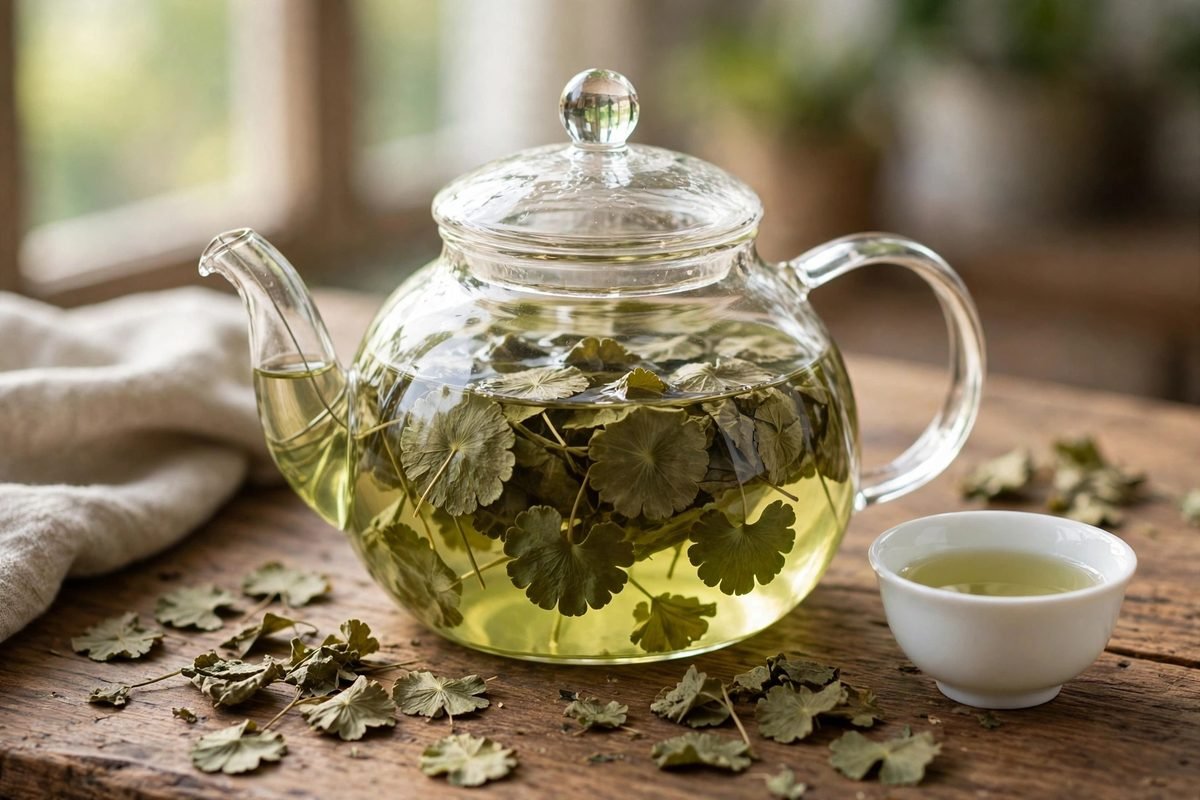
Gotu kola is the leaf of Centella asiatica, a small creeping plant of Asian wetlands. It belongs to the carrot family (Apiaceae) and has fan-shaped leaves. In Ayurveda it is called mandukaparni. The tea is a simple infusion of the dried (or fresh) leaves in hot water.

Two mix-ups first:
- It is not kola nut. Despite the name, gotu kola is unrelated to the kola nut and contains no caffeine.
- “Brahmi” can mean two different plants. In Ayurveda the name brahmi has been applied to both gotu kola (Centella asiatica) and bacopa (Bacopa monnieri). They are different plants, so check the Latin name on any product you buy.
Its active compounds are triterpenoids — mainly asiaticoside and madecassoside. Most human research used standardised extracts of these compounds, not tea. That difference matters, and this article flags it every time.
1. Memory and Focus — the Honest Verdict
This is the claim most people come for, and where the evidence is thinnest. A 2017 review and meta-analysis pooled 11 randomised trials of Centella asiatica and found no significant difference from placebo in any cognitive domain — not working memory, not verbal memory, not visual memory. That is the strongest summary we have, and it does not support a memory-boosting claim for the herb, let alone for a cup of tea. (Puttarak et al., Scientific Reports, 2017)
One brighter spot: a small trial in 28 healthy older adults gave 250, 500 or 750 mg of extract daily for two months, and the highest dose improved working memory and mood. (Wattanathorn et al., Journal of Ethnopharmacology, 2008) But it is a tiny study — 7 people per group — and it used extract, not tea. Memory is a maybe, not a promise.
2. Calm and Mood
The same 2017 meta-analysis found more for mood than for memory: people taking gotu kola reported higher alertness and lower anger scores one hour after a dose — alertness plus calm, matching the traditional picture of a herb that steadies the nerves without making you drowsy. (Puttarak et al., 2017)
An older trial agrees. In 40 healthy adults, a single 12 g dose softened the acoustic startle response — the flinch at a sudden loud noise — 30 and 60 minutes later, with no change in heart rate or blood pressure. The authors called this preliminary evidence of anti-anxiety activity. (Bradwejn et al., Journal of Clinical Psychopharmacology, 2000) One small, old trial is not proof, but it is a real human signal. For a similar gentle evening herb, see lemon balm tea benefits.
3. Heavy Legs and Circulation
The best-supported use in human trials is not the brain — it is the legs. A 2013 review of eight randomised trials on chronic venous insufficiency (heavy, aching legs and swollen ankles) found that Centella asiatica improved microcirculation and the rate of ankle swelling, and three further trials reported less leg heaviness, pain and swelling. (Chong & Aziz, Evidence-Based Complementary and Alternative Medicine, 2013)
Every one of those trials used standardised extracts over 4 to 8 weeks — not tea. A cup of tea is a much weaker, unstandardised dose, so it would be wrong to present it as a treatment for vein problems. Circulation has the most human-trial support, but the support belongs to extracts — anyone with leg swelling or vein trouble should see a clinician rather than self-treat.
4. Skin and Wound Healing
Gotu kola’s oldest traditional use is for skin: wounds, burns, scars and slow-healing sores. Europe’s herbal medicines committee (EMA/HMPC) recognises Centella asiatica herb for traditional use in minor wounds and skin disorders — not a proven-treatment claim. (EMA herbal monograph, EMA/HMPC/489142/2020, 2022)
The mechanism is plausible: asiaticoside and madecassoside stimulate collagen production and new blood-vessel formation in lab studies, key steps in wound repair. But “plausible in the lab” is not “proven in people drinking tea”, and no trial has tested gotu kola tea for skin. Think of this as a traditional use with a sensible mechanism — not a skin treatment. If you want a herb with stronger skin-and-calm crossover, ashwagandha tea is the closest companion on this site.
5. Antioxidant Protection
Gotu kola’s triterpenoids and flavonoids show antioxidant activity in laboratory studies — they neutralise free radicals and support the body’s own antioxidant enzymes in animal models. That is genuine science, but a long way from a benefit in a person: almost every green leafy herb shows antioxidant activity in a test tube. Treat this as background chemistry, not a reason to drink the tea.
6. A Gentle Evening Ritual
Gotu kola tea is naturally caffeine-free, mild and slightly grassy — an easy evening cup. Traditional use pairs it with winding down: Himalayan yogis have long used it as a meditation aid, and Ayurveda counts it among calming nervine tonics. No trial proves a sleep effect, and this article claims none. But as a ritual — a warm, caffeine-free cup replacing a late coffee — it earns its place. If sleep is the goal, chamomile tea for sleep has the stronger evidence base on this site.
7. A Traditional Tonic for Everyday Resilience
In Ayurveda, gotu kola is a rasayana — a rejuvenating tonic said to support longevity and vitality. That is tradition, not trial evidence: no study has tested “vitality” or “longevity” in people drinking gotu kola tea. Do not mistake a long history for proof of effect.
Tea vs Extract: The Gap No Ranker Explains
Here is the single most important thing to understand about gotu kola tea benefits:
| What the trials used | What your cup contains | |
|---|---|---|
| Dose | 250–750 mg of standardised extract a day, or a single 12 g dose | About 1 teaspoon of dried leaves, unstandardised |
| Known triterpene content | Measured and fixed (e.g. 37.5 mg pentacyclic triterpenes in a 750 mg dose) | Unknown — varies by leaf, harvest and steep time |
| Duration | 2 months, or 4–8 weeks for vein trials | One cup, whenever you feel like it |
| Evidence | Small human trials, pooled in reviews | No trial has tested tea itself |
So when a blog says “gotu kola tea improves memory”, it is borrowing numbers from an extract trial and pasting them onto a cup of tea. This article does not do that. The tea is a gentle, traditional, caffeine-free infusion; the extract is a concentrated preparation with small-trial evidence. They are not the same thing.
How to Brew Gotu Kola Tea
The method is simple, and the amounts below are exact.

Simple Gotu Kola Tea
Ingredients
Method
- Put the leaves in the cup.
- Pour over the just-boiled water.
- Cover and steep for 10 to 15 minutes.
- Strain out the leaves.
- Add honey or lemon if you like, and drink warm.
You need: 1 teaspoon dried gotu kola leaves, 1 cup (240 ml) just-boiled water, a cup and a strainer. Optional: 1 teaspoon honey, 1 squeeze of lemon.
Method: Put the leaves in the cup. Pour over the just-boiled water. Cover and steep for 10 to 15 minutes. Strain out the leaves. Add honey or lemon if you like, and drink warm. One cup, once or twice a day, is the usual traditional amount.
Tips: Cover the cup while it steeps. Fresh leaves work too — use a small handful (about 1 tablespoon) instead of the dried teaspoon. The taste is mild, grassy and slightly bitter; honey rounds it off.

Safety: Who Should Skip Gotu Kola Tea
Gotu kola is one of the stricter herbs on this site for safety — the risk is not theoretical. Read this before making it a habit.
- Pregnancy and breastfeeding — avoid. Safety data are lacking, and traditional sources advise against use in pregnancy. Do not drink it while pregnant or trying to conceive.
- Liver disease — avoid. Rare but serious liver injury has been reported: in one case series, three women developed jaundice after 20 to 60 days of use, and one woman’s injury returned when she took it again. (Jorge & Jorge, 2005) If you have liver disease, skip gotu kola — and seek advice if you develop yellowing skin or eyes, dark urine, or upper-belly pain.
- Sedative medicines — check first. Gotu kola may add to drowsiness from sleep and anxiety medicines. Tell your doctor or pharmacist before combining them.
- Surgery — tell your team. Tell your surgeon about any herbal tea you drink regularly.
- Children — not recommended. No safety data exist for children, and one case of liver injury has been reported in a child.
- Allergies — rare but real. Some people develop a skin rash from gotu kola. Stop if one appears.
- Long-term daily use — no safety data. The vein trials ran 4 to 8 weeks; long-term oral safety is not established. Treat gotu kola tea as an occasional cup, not a permanent daily habit.
Common side effects are usually mild: headache, dizziness, nausea or an upset stomach, and drowsiness. MedlinePlus lists the same cautions. If any side effect appears, stop the tea and talk to a clinician.
Frequently Asked Questions
Is gotu kola tea good for memory?
Honestly: not proven. A 2017 meta-analysis of 11 trials found no significant memory benefit over placebo. One small trial in 28 older adults found working-memory gains at 750 mg of extract a day, but that was extract, not tea. Drink it because you enjoy it, not as a memory treatment.
Does gotu kola tea contain caffeine?
No. Gotu kola is unrelated to the kola nut and contains no caffeine. It is a caffeine-free herbal infusion, safe for the evening in that respect.
Is gotu kola the same as brahmi?
Partly. The name brahmi has been used for both gotu kola (Centella asiatica) and bacopa (Bacopa monnieri). They are different plants. Always check the Latin name — Centella asiatica — on the packet.
How often can I drink gotu kola tea?
Traditionally, 1 cup once or twice a day, steeped 10 to 15 minutes. There is no established safe long-term daily dose for the tea, so take breaks and do not drink it every day for months on end.
Who should avoid gotu kola tea?
Pregnant and breastfeeding women, people with liver disease, children, and anyone taking sedative medicines or medicines that strain the liver — unless a clinician says otherwise. See the safety section above for the full list.
The Bottom Line
Gotu kola tea is a gentle, caffeine-free infusion with a long traditional history and a small, honest evidence base: modest mood and alertness signals, the best trial support for heavy legs (from extracts, not tea), a traditional skin-healing reputation, and a memory claim that the largest review does not support. Its safety fine print is stricter than most herbs on this site — especially the rare liver-injury reports — so it is a tea to drink occasionally and carefully, not daily and casually. If calm is what you are after, linden tea is a gentler everyday companion.
Medical disclaimer: This article is for general information only and is not medical advice. Herbal teas can interact with medicines and medical conditions. Talk to your doctor or pharmacist before using gotu kola, especially if you are pregnant, breastfeeding, have liver disease, or take regular medication.
Sources
- Puttarak P, et al. Effects of Centella asiatica (L.) Urb. on cognitive function and mood related outcomes: A Systematic Review and Meta-analysis. Scientific Reports, 2017; 7:10646. PMID 28878245
- Wattanathorn J, et al. Positive modulation of cognition and mood in the healthy elderly volunteer following the administration of Centella asiatica. Journal of Ethnopharmacology, 2008; 116(2):325–332. PMID 18191355
- Bradwejn J, et al. A double-blind, placebo-controlled study on the effects of Gotu Kola (Centella asiatica) on acoustic startle response in healthy subjects. Journal of Clinical Psychopharmacology, 2000; 20(6):680–684. PMID 11106141
- Chong NJ, Aziz Z. A Systematic Review of the Efficacy of Centella asiatica for Improvement of the Signs and Symptoms of Chronic Venous Insufficiency. Evidence-Based Complementary and Alternative Medicine, 2013. PMID 23533507
- Jorge OA, Jorge AD. Hepatotoxicity associated with the ingestion of Centella asiatica. Revista Española de Enfermedades Digestivas, 2005; 97(2):115–124. PMID 15801887
- European Medicines Agency. European Union herbal monograph on Centella asiatica (L.) Urb., herba, Revision 1. EMA/HMPC/489142/2020, adopted 30 March 2022. EMA monograph page
- MedlinePlus (U.S. National Library of Medicine). Gotu Kola. medlineplus.gov/druginfo/natural/985.html


